Hidden Water Leak Detection in Atlantic City, NJ
Pinpoint concealed supply and drain leaks behind finished walls, under flooring, and inside ceilings across Atlantic City properties. Call our diagnostic specialists at (201) 510-1615 for non-invasive acoustic and thermal testing that preserves your interior finishes.
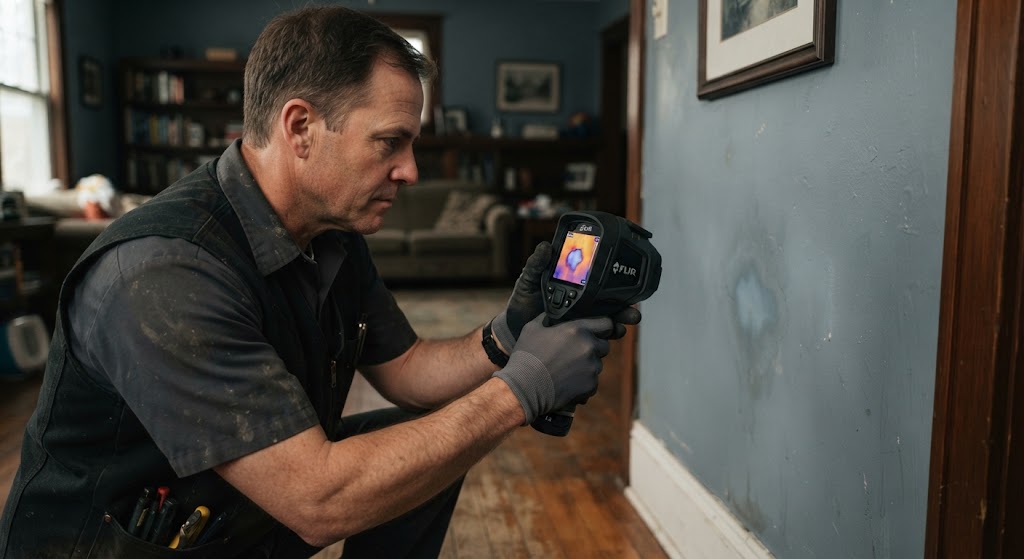
Concealed Water Leaks in Atlantic City Architecture
Concealed pipe breaches are among the most deceptive plumbing failures facing property owners on Absecon Island. Because pressurized water travels along the path of least resistance—often cascading along horizontal ceiling joists, down vertical wall studs, or pooling under subflooring—the visual moisture stain is rarely directly aligned with the pipe fissure. Professional hidden water leak detection in Atlantic City NJ eliminates exploratory tearing of sheetrock by deploying specialized non-invasive diagnostic tools.
In Atlantic City’s coastal climate, older residences in Ducktown and historic homes throughout Chelsea frequently house aging copper distribution lines encased in plaster or drywall. Moisture trapped within enclosed wall cavities accelerates structural wood rot and degrades indoor air quality. By mapping thermal differences and acoustic frequencies, our technicians isolate the breach before significant structural deterioration takes place.
Warning Signs of Concealed Moisture Intrusion
Watch for these distinctive indicators of hidden water leakage within your home or commercial building:
- Soft, discolored, or bubbling drywall patches that gradually expand along interior partition walls.
- Unexplained ticking, dripping, or faint hissing sounds audible inside walls when no fixtures are active.
- Buckling baseboards, cupping wood plank flooring, or loosened floor tiles near plumbing stacks.
- Damp, stale odors lingering inside vanity cabinets, linen closets, or basement utility corners.
- Unusually high water meter readings with no identifiable increase in daily property consumption.
Local Environmental Causes Accelerating Hidden Leaks
Atlantic City’s barrier-island geography creates unique plumbing stress. High ambient humidity combined with airborne marine salt accelerates external pitting and pinhole oxidation on copper piping concealed in wall cavities. Furthermore, fine barrier-island sand foundation shifts during coastal tidal surges cause subtle settling in older structures near the Inlet and along the Boardwalk district, straining soldered elbow joints and threaded transitions over decades.
Step-by-Step Non-Invasive Detection Protocol
-
System Pressure & Isolation Testing
We test the static pressure across your domestic hot and cold supply lines to isolate whether the loss occurs on a pressurized line or a drainage run.
-
High-Resolution Thermal Infrared Imaging
Infrared thermography maps temperature differentials across wall cavities and ceiling surfaces, revealing evaporative cooling signatures where water spreads.
-
Acoustic Frequency Pinpointing
Ultrasonic listening discs and sensitive ground microphones pick up the high-frequency vibration of escaping pressurized water within structural framing.
-
Calibrated Moisture Mapping
Non-penetrating radio-frequency moisture meters map the saturation boundary, verifying the exact focal point for surgical plumbing access.
What Happens After the Leak Is Pinpointed
Once the exact coordinates of the pipe failure are identified, you receive a precise diagnostic briefing showing the breach location and severity. Because the failure point is known to within inches, physical opening is limited to a small access window. In New Jersey, permanent plumbing repairs and line modifications must be performed by a NJ licensed master plumber to ensure strict adherence to state uniform construction code standards.
Diagnostic Scope Factors & Prevention Advice
The time and equipment required to diagnose a hidden leak depend on several site-specific variables, including the depth of the pipe run, whether lines run behind tile, plaster, or drywall, and whether multiple branch lines share common chases. To protect your property, install accessible shut-off valves, inspect crawlspace pipe runs before freezing winter weather, and monitor monthly water bills closely.
Atlantic City Neighborhoods Frequently Serviced
Hidden water intrusion occurs across all sections of Atlantic City, including turn-of-the-century residences in Ducktown, coastal duplexes throughout Venice Park, and waterfront residences near Gardner’s Basin. Learn more about our comprehensive service scope across the city on our Service Areas overview.
Frequently Asked Questions
How do you detect hidden leaks behind drywall without cutting?
We combine thermal imaging cameras that detect evaporative cooling patterns with calibrated acoustic sensors and electromagnetic moisture meters to isolate pipe leaks behind wall coverings without unnecessary exploratory holes.
Why are hidden leaks common in Atlantic City coastal homes?
Salt-laden marine air causes accelerated atmospheric oxidation on copper and brass pipe fittings inside wall cavities, while shifting barrier-island sand places micro-stress on pipe joints over time.
What should I do right after discovering a damp wall patch?
Check your water meter to confirm active flow, take date-stamped reference photos, turn off the localized water shut-off valve if accessible, and call our diagnostic line at (201) 510-1615.